
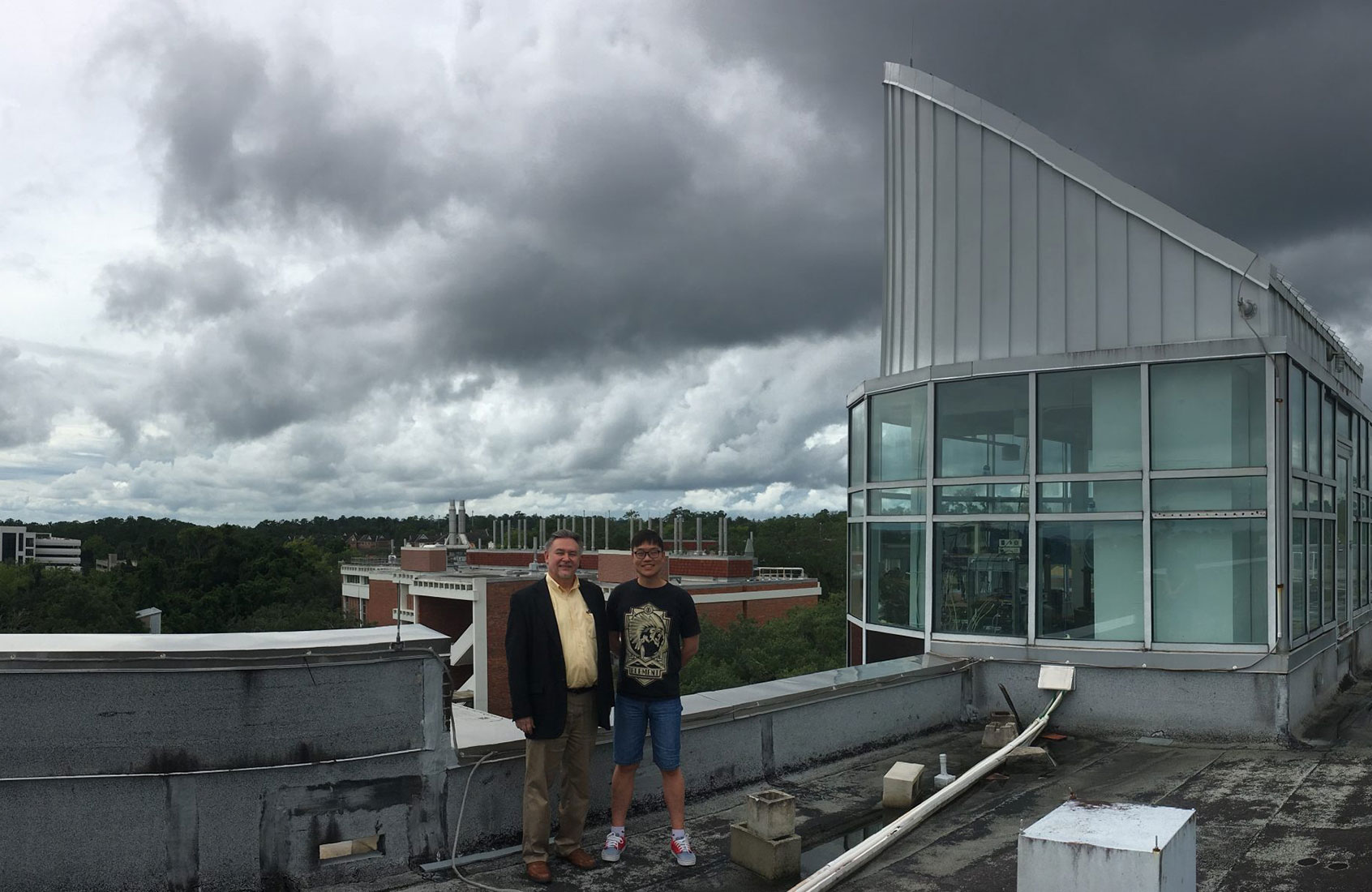
University of Florida postdoctoral researcher Ziqin Ding, Ph.D., and his team are working on a project to protect cell towers and other tall objects from lightning strikes. Using a novel combination of antennas, sensors, and algorithms, Ding’s system is able to detect if a particular lightning strike has impacted a given structure or not.
How is this possible? It’s all a matter of having the right data, said Ding, who has been studying lightning in the Department of Electrical & Computer Engineering for eight years.
As a postdoctoral researcher working with ECE distinguished professor and director of the International Center for Lightning Research & Testing Vladimir Rakov, Ding spent years amassing lightning strike data at the Lightning Observatory in Gainesville, or LOG, a facility that includes the glass cupola on top of the New Engineering Building.
The cupola houses computers, digitizing oscilloscopes and high-speed video cameras. In addition, various sensors — electric field antennas, electric field derivative antennas, magnetic field derivative antennas and X-ray/Gamma-ray detectors — are located nearby on the building’s roof. Data from these devices are recorded continuously, filling local and cloud servers managed by the lightning research group.
The project is detailed in a paper titled “Identification of Lightning Strikes to Towers Using Their Electric Field Signatures and a Machine Learning Approach,” which is set to be published this month in IEEE Sensors Journal. The data underpinning the project was collected as part of a study funded by the National Science Foundation.

Ding’s recent work harvests the center’s data using machine learning to ingest the electromagnetic signatures of the thousands of lightning strikes in the database. The signatures are compared to ground-truth data, allowing the system to learn which signatures are associated with strikes on tall structures. He has essentially created a system that uses ground-truth data, combined with machine learning algorithms, to intelligently determine whether a given lightning strike does or does not strike a particular tall structure in real time.
Think of his system like a black box attached to a special sensor. It detects a strike and then labels it as either “strike to tall object” or “no strike to tall object.” As 5G towers become more ubiquitous and modern life increasingly relies on solid data transmission, knowing that a tower is hit by lightning in real time can help minimize damage and disruption to critical infrastructure.
Machine learning was a natural fit for the task at hand, according to Ding. It’s fast, accurate, easy to implement and easy to upgrade. And the system can be continuously retrained as more data are collected. And Ding has something other researchers do not: masses of data collected in Florida, the state usually ranked No. 1 in lightning strikes per year.
This type of work is, by its nature, collaborative. Ding’s colleague Si Chen, an ECE Ph.D. student, identified tower strikes in the ground-truth dataset. The lab run by ECE Associate Professor Joel Harley, Ph.D., and ECE graduate student Hanbo Yang provided expertise in algorithm development.