
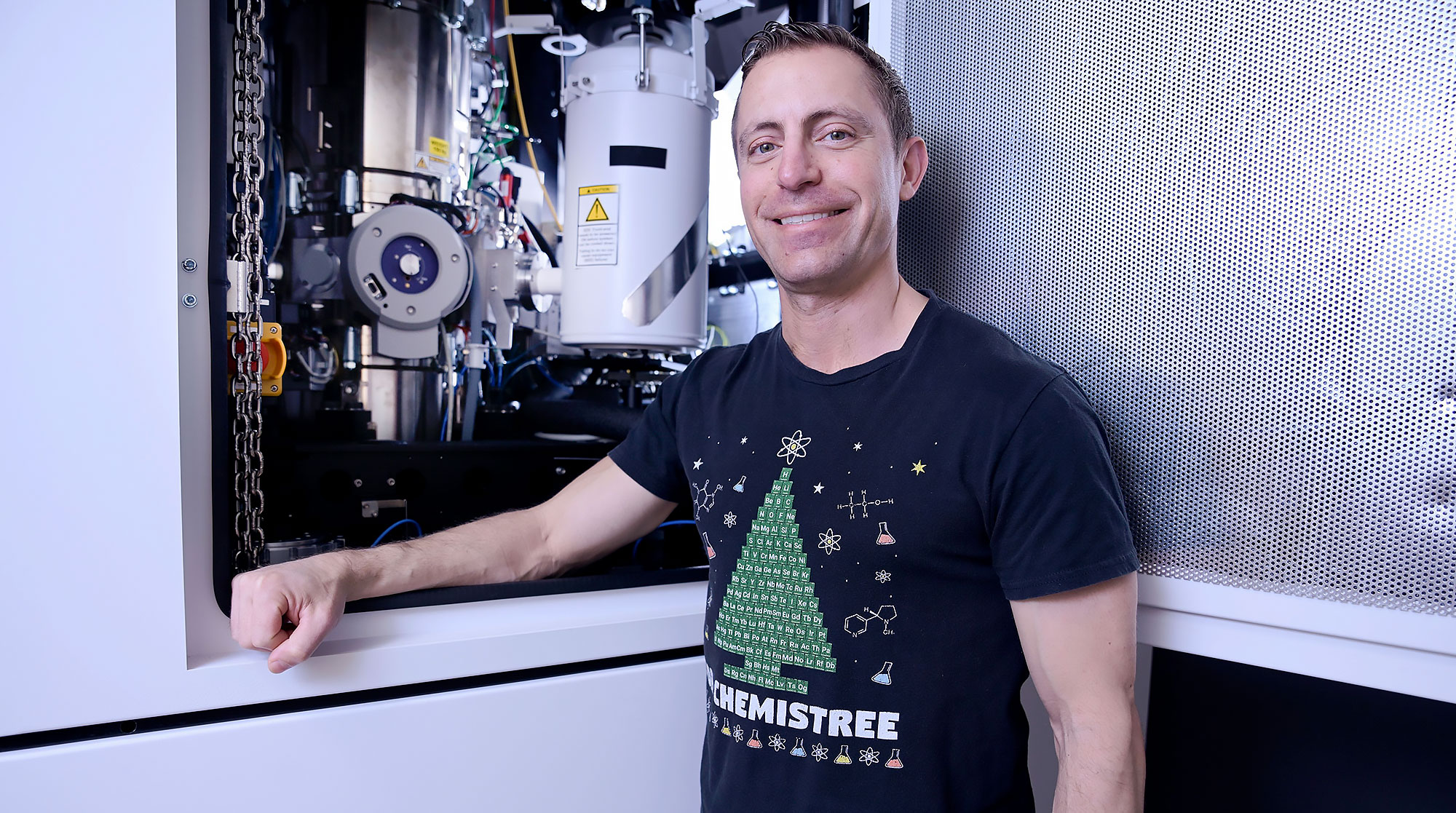
- UF engineer and electron microscopy expert Nicholas Rudawski uses YouTube to help others learn to operate electron microscopes and understand electron microscopy concepts and fundamentals.
- He created an open-access electron microscopy-related YouTube education channel with more than 5,700 subscribers and hundreds of thousands of views worldwide.
- He champions approachable scientific communication, which helps students, researchers and industry professionals worldwide.
Nicholas Rudawski, Ph.D., an electron microscopy expert at the University of Florida’s Nanoscale Research Facility (NRF), is helping students and researchers from around the world use electron microscopes and understand electron microscopy, one video at a time.
Rudawski, an associate engineer, earned his bachelor’s degree in materials science and engineering from the University of Michigan in 2005 and his doctorate from UF in 2008. He joined the NRF as faculty in 2012, where he oversees training, operations and maintenance of scanning/transmission electron microscopes, known as S/TEMs.
In the fall of 2018, while teaching a graduate course on electron microscopy, his students expressed interest in seeing live demonstrations of instrument operation. As the S/TEM was located in a specialized, restricted laboratory area, he began recording short iPhone videos of himself using the equipment to give students a closer look at the process.
After much consideration, he concluded YouTube would be the fastest, most accessible way to share the videos. What started as a teaching aid soon attracted viewers far beyond his classroom, attracting people from around the world.
Rudawski soon realized he was reaching a far larger audience than expected. By the fall of 2020, the number of subscribers to his channel surpassed 1,000. In early 2026, that number increased to over 5,700. On average, he gains about 1,000 subscribers each year.
“People found these videos, and it just took off from there. It was a snowball effect in the beginning,” said Rudawski. “I didn’t realize there would be such a large audience for these videos. People often told me they relied heavily on my videos because they don’t have people at their facilities to assist them or train them.”
Rudawski has improved the production considerably since the original iPhone videos and has embraced social media in science education. His most popular video has more than 43,000 views; it shows him using an iPhone to record himself operating an FEI Tecnai F20 S/TEM to perform basic TEM imaging. His goal is to present scientific information in an accessible way.
“Once I realized there was this audience, I just kept making videos,” he said. “I make it a priority to be welcoming to a wide range of viewers and particularly people who may have a more limited understanding of electron microscopy,” he said.
Feedback has been overwhelmingly positive. One YouTuber wrote: “This quality of scientific content on YouTube is rare. Excellent demonstration.”
His subscribers are constantly asking for new videos, too.
“There’s no shortage of requests,” he said. “Viewers are always asking me to make videos on different topics. With electron microscopy, there’s so much possible content, it’s basically limitless. I just go where it takes me and where people want me to go.”
In his current position, he works closely with students, researchers and UF professors, as well as partners from industry, to use electron microscopy. They study and process a wide range of materials and specimens, including metals, ceramics, semiconductors, complex oxides, nanoparticles, electronic devices, two-dimensional materials and even some biological specimens.
He also serves as co-principal investigator with Professor Parag Banerjee, Ph.D., from the University of Central Florida on a project to use advanced electron microscopy to study long-wave infrared transparent ceramics.
“It’s very much an international audience; I usually receive two or three emails per week from people thanking me for my channel,” said Rudawski. “My YouTube channel ultimately serves as an open forum for the exchange of electron microscopy-related information, which benefits the microscopy community.”
His growing online reach points to how UF research and teaching extend worldwide.
“Nick’s story is a great example of the impact of UF,” said Michael Tonks, Ph.D., interim chair of the Department of Materials Science & Engineering. “He decided to take videos he was already making as part of his job and post them on YouTube, where everyone can access them. He now has viewers from across the world who find his videos very valuable.”