
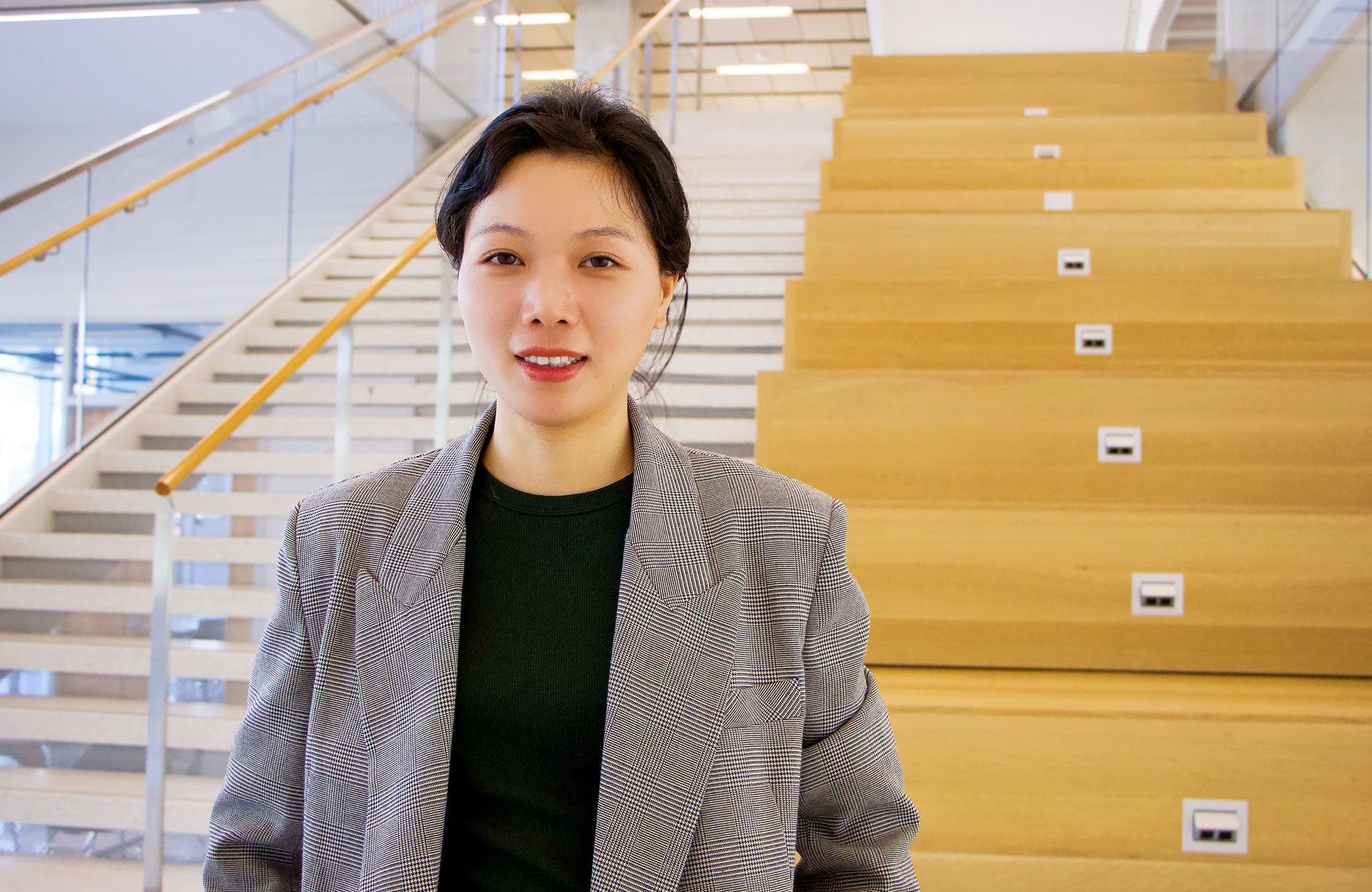
Question: What fascinated you about quantum research?
I am always driven by curiosity and by the desire to understand the unknown. I am particularly drawn to exotic phenomena that cannot be fully explained by existing physical laws and formulas. Quantum is one such area, where effects like the fractional quantum Hall phenomenon and quantum entanglement still challenge our current theoretical and experimental framework.
How well are UF engineering students positioned for quantum-related jobs after graduation?
UF engineering students are well positioned for quantum-related careers thanks to our related courses, interdisciplinary skill sets and growing campus resources such as UF Quantum Initiative.
The quantum technology sector faces a significant talent shortage, and many entry-level roles — especially in quantum software, control systems, electronics and cryogenic engineering — can be filled by graduates with solid backgrounds in electrical engineering, computer engineering or physics-adjacent fields. Our department has a strong foundation in semiconductor physics, the basis of all modern electronic and quantum devices.
“Even though quantum engineering sounds abstract, the technologies it enables are very real: faster computers, scalable devices, and accuracy/high fidelity to store and process information.”
– Yingying Wu, Ph.D.
We also offer several quantum-focused courses such as Spintronics for Quantum Technology (taught by me), Introduction to Quantum Computing (Professor Jing Guo, Ph.D.), Introduction to Quantum Devices and Quantum Engineering (Professor Philip Feng, Ph.D.), Nano and Quantum Photonics and Applications (Professor Laura Kim, Ph.D.) and From Qubits to Quantum Sensors (Professor Elham Heidari, Ph.D.). These courses provide undergraduate and graduate students with broad exposure to quantum science and engineering.
Additionally, Professor Feng is leading our department’s efforts to advance quantum technologies in the state of Florida, helping to grow and train the local quantum workforce. With the addition of young faculty like myself and Laura in quantum-related areas, UF is well positioned to lead this emerging research thrust.
What is UF doing to be a leader in quantum research and education?
I see strong momentum and growing attention toward developing quantum research and education at UF. One challenge is that Florida currently lacks federally supported quantum centers, unlike institutions such as the University of Chicago or Harvard. At the same time, we are increasingly recognizing the need to build a local quantum workforce, which is why our department is taking the lead in driving new quantum initiatives across the university and the state.
How do you describe your job and research to non-quantum friends and relatives?
I work on understanding and controlling the electron, spin and magnetic effects that follow the rules of quantum mechanics — the laws that govern the smallest building blocks of nature. Even though quantum engineering sounds abstract, the technologies it enables are very real: faster computers, scalable devices, and accuracy/high fidelity to store and process information.