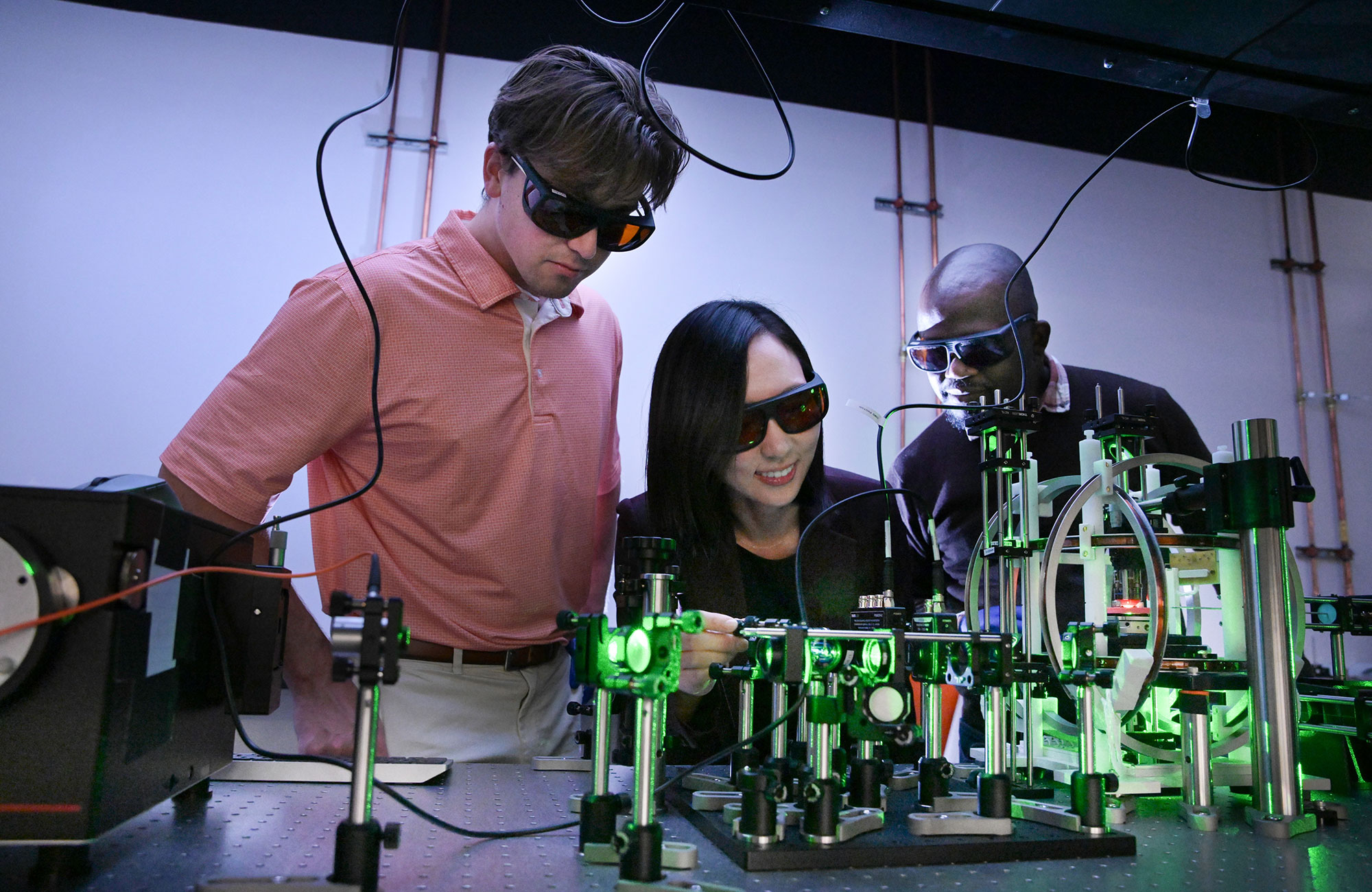
To get a good window into what the University of Florida is doing in the quantum space, spend some time with Laura Kim, Ph.D., and Yingying Wu, Ph.D.
Both are award-winning assistant professors in the Department of Electrical & Computer Engineering, and both are gaining attention for their work in quantum research and education.
Earlier this year, Kim won a DARPA Young Faculty Award in support of her project “Room-Temperature Strong Coupling in Intercalated 2D Plasmonic Systems.” The project seeks to harness light-matter interactions, typically only observed at ultra-cold temperatures, and bring them into everyday, room-temperature conditions by engineering atomically thin materials that squeeze and guide light with extraordinary precision.
These ultracompact structures not only reveal new hybrid states of light and electrons, but they may also serve as powerful quantum sensors, capable of detecting tiny changes in their environment without requiring bulky cryogenic setups.
Step into Kim’s lab and you’ll hear about quantum sensors and, with the proper lens, see green laser light shining off a diamond plate containing tiny defect centers that act as exceptionally sensitive quantum probes. By combining these diamond-based sensors with advances in 2D materials, Kim’s group is working toward technologies that could diagnose the health of electronic devices without taking them apart or inspire less-invasive medical tests.
“The reason I am fascinated by quantum sensors is they can reveal physical phenomena that are simply inaccessible with conventional methods,” Kim said. “Some of the things that can happen inside a material are known to exist theoretically, but we have never had experimental tools to observe them directly. Quantum sensors give us a way to finally see these hidden phenomena and turn theory into something we can measure and understand.”
Wu received a National Science Foundation CAREER Award to fund her project, “Transforming Quantum Spintronics with Novel 2D Magnetic Transistors and Diodes.”
This project focuses on creating new quantum hardware devices like quantum transistors and diodes that use nanoscale magnetic skyrmions (tiny, stable structures with unique quantum properties). These devices will be designed to be more energy-efficient and scalable; they can operate at elevated temperatures, helping overcome some of the biggest obstacles in quantum computing like high error rates.
“I am always driven by curiosity and by the desire to understand the unknown,” Wu said. “I am particularly drawn to exotic phenomena that cannot be fully explained by existing physical laws and formulas.”