Education
Pursuing interdisciplinary education.
The challenges posed by artificial intelligence span multiple domains, from societal and environmental to technological, geopolitical, and economic. Our educational initiative aims to develop well-rounded professionals who can navigate these interconnected and intersecting challenges through:
- Integrating diverse knowledge domains to develop AI systems that are more intelligent, adaptable, and universally beneficial.
- Understanding technical challenges through varied lenses: cultural, philosophical, economic, and historical.
- Building collaborative competency by equipping technologists with the shared vocabulary and interdisciplinary understanding needed to work effectively with social scientists, legal experts, and business leaders.
Interdisciplinary MS in AI Safety
Glenn Renwick challenged us to educate students who can provide answers to the pressing ethical questions facing AI today. To meet this challenge, we are developing the first interdisciplinary Master’s program in AI Safety: a two-year degree designed to bridge technical expertise with ethical reasoning and policy literacy.
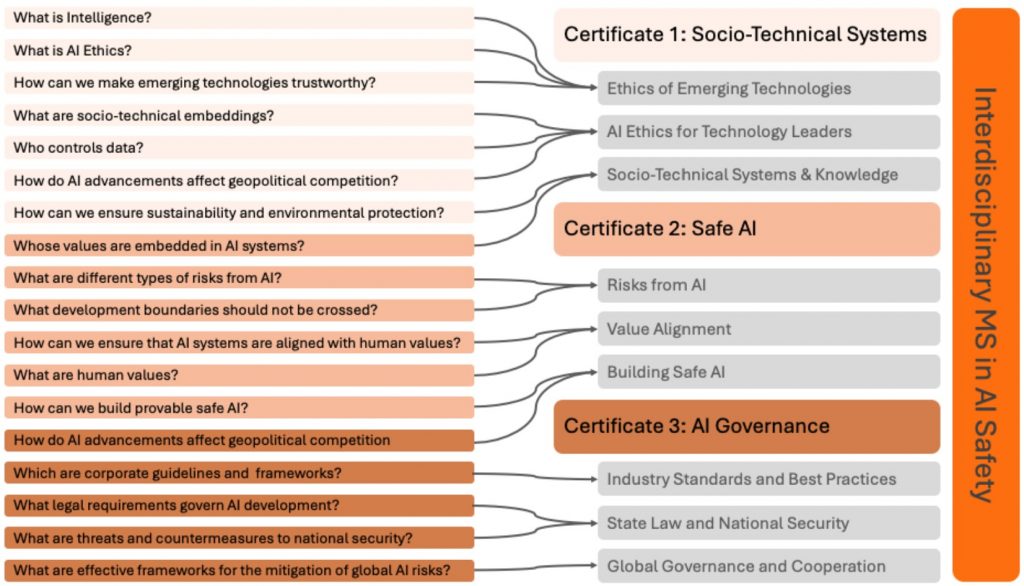
- Certificate 1 (Socio-Technical Systems) examines the ethics of emerging technologies, equipping future technology leaders to understand AI as deeply intertwined with social, political, and environmental contexts.
- Certificate 2 (Safe AI) addresses the technical and philosophical foundations of AI safety, from risk assessment to building provably safe systems.
- Certificate 3 (AI Governance) prepares students at three different levels of governance: organizational, national and global.
The program culminates in a capstone project developed in partnership with industry, giving students hands-on experience translating principles into practice. Beyond the graduate program, we are also developing undergraduate courses and secondary education resources to build a pipeline of ethically informed AI practitioners at every level.

Distinguished Speakers Series: AI Ethics in Practice
The Engineering Leadership Institute’s graduate course “AI Ethics for Technology Leaders” (ENG6933) equips future technology leaders with a comprehensive understanding of critical ethical considerations in AI development and deployment.
During the Fall 2024 and Spring 2025 semesters, students heard from leading industry experts, ethicists, and researchers who shared valuable insights on navigating the complex ethical landscape of artificial intelligence. Below is a curated selection of recorded guest lectures, providing diverse perspectives on pressing ethical challenges in AI.
A Large-Scale Survey and Dataset of Media-Based Misinformation In-The-Wild
By Nick Dufour, Staff Research Engineer at Google DeepMind, where he is a lead on the Media Integrity Team.
Using machine learning to increase equity in healthcare and public health
By Emma Pierson, Zhang Family Endowed Professor and Assistant Professor of Computer Science at UC Berkeley.
Sociotechnical Harms of Algorithmic Systems
By Rene Shelby, Visiting Fellow at the Justice and Technoscience (JusTech) lab at Australian National University and Staff Research Scientist at Google Research.
Computational Approaches for Characterizing Culture
By Scott Friedman, Principal Researcher at Smart Information Flow Technologies specializing in artificial intelligence.
How EU and California regulate AI – A European Union practitioner’s view
By Joanna Smolinska, Counsellor for Digital and Deputy Head of the EU Office in San Francisco.
Alignment and the Hum(AI)n Domain
By Adam Russell, AI Division Director at the Information Sciences Institute.
What do you value, and Why?
By Andrew Smart, Senior Research Scientist at Google Research and its Responsible AI Impact Lab.