

Lifelong Learning Model Draft Two


Lifelong Learning is the ongoing, self-directed pursuit of knowledge for personal and professional purposes. It involves self-directed learning, supportive social networks, access to learning resources, and a positive learning environment. Lifelong learning is essential in professions such as law, medicine, engineering, and pharmacy. Academic training is just the beginning, with ongoing education and training continuing throughout a practitioner’s career.

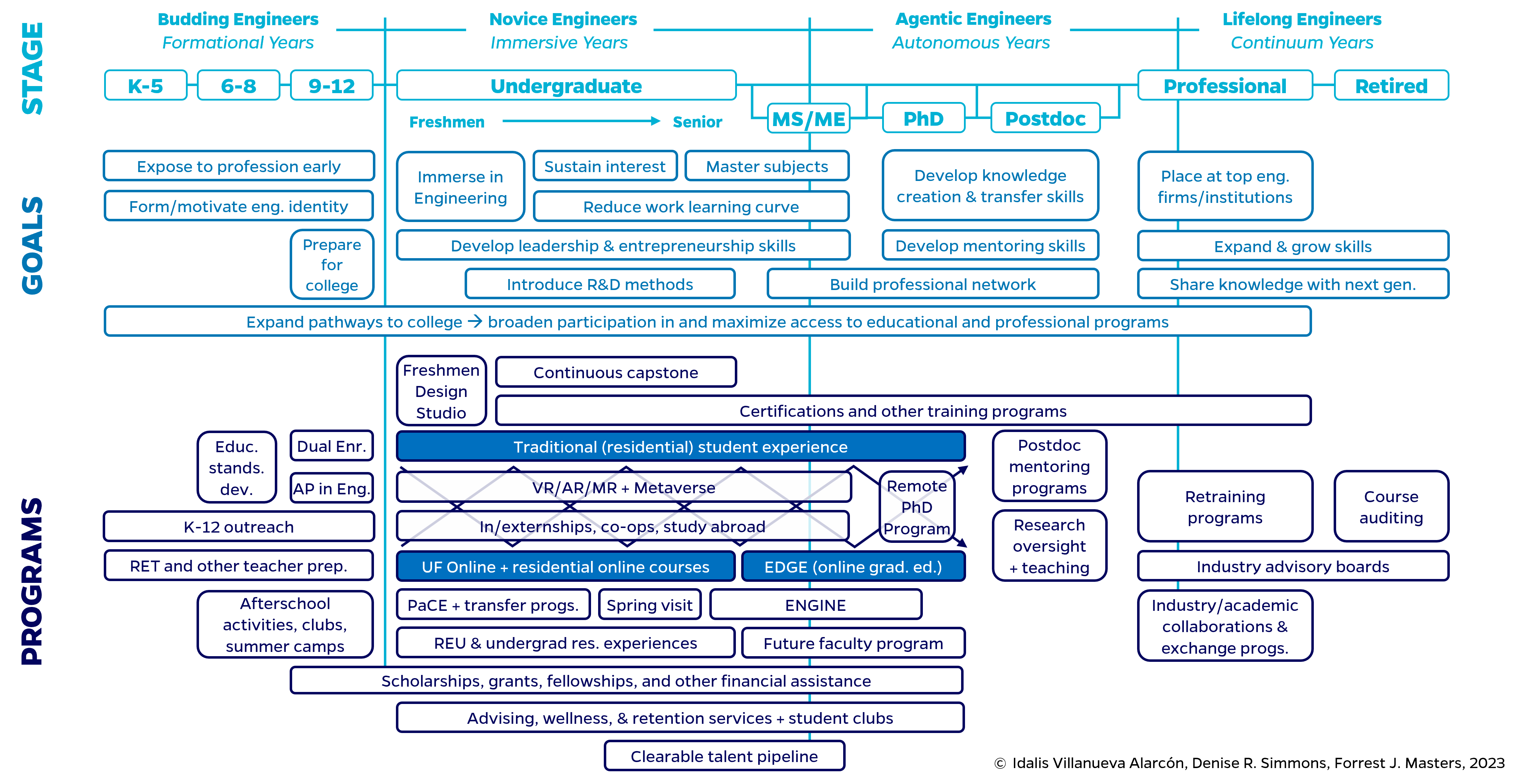
The lifelong learning model developed by Dr. Idalis Villanueva Alarcón, Dr. Denise R. Simmons, and Dr. Forrest J. Masters focuses on four phases of the budding, the novice, the agentic, and lifelong learning engineers. An image of the model can be found here.

Four Phases of Lifelong Learning


Budding Engineers

Formational Years (K-12)

The Budding Engineer Phase consists of the foundational years for future engineers. During their K-12 education, students are exposed to the engineering profession, gaining motivation and beginning to form their engineering identity.

Goals: Provide early exposure to the profession, form and motivate an engineering identity, and prepare students for college.

Developed Programs/Initiatives: curriculums developed for technical schools(AI and data science courses), summer camps (computer science Goldberg camp, etc), Industry-backed competitions (AI competition), teacher PD programs (Azure certification, etc.), Step-Up, SECME, EFTP Program, Eweeks, RET.

In Development Initiatives: Development of  Engineering AP course and educational standards, establish more UF/industry-branded activities (AI competitions, etc.), develop an online Master’s tied to critical certification needs for teachers, and establish a program fee model. 

Sample of Faculty and Experts: Nancy RuzyckiChristina Gardner

Novice Engineers

Immersive Years (Undergraduate – MS/ME)

The Novice Engineer Phase primarily consists of an engineer’s undergraduate and early graduate studies. During this phase, they become immersed in engineering, sustain their interests, and build the skills necessary for their imminent career.

Goals: Immerse students in engineering to sustain their interest and master subjects, reduce the work-learning curve, develop leadership and entrepreneurship skills, and introduce research and development methods.

Developed Programs/Initiatives: EDGE (online graduate program), PaCE, ENGINE, UF Online + residential online courses, REU & undergrad residential experiences, continuous capstone, freshmen design studio, certifications, and other training programs.

In Development Initiatives: Develop data-driven blended learning

Sample of Faculty and Experts: Fernando J. Mérida Figueróa, Sindia Rivera

 Agentic Engineers

Autonomous Years (PhD. Postdoc)

The Agentic Engineer Phase sees engineers at their most autonomous. During this phase, they actively practice their profession, completing graduate education and postdoctoral studies. These engineers are building their professional networks, developing mentoring and leadership skills, and working towards becoming leaders in their fields.

Goals: Develop knowledge creation and transfer skills, develop mentoring skills, and build a professional network.

Developed Programs/Initiatives: Postdoc mentoring programs, research oversight, teaching, and future faculty programs.

Lifelong Engineers

Continuum Years (Professional – Retired)

The Lifelong Engineer Phase encompasses the years of an engineer’s professional career up to and including retirement. These engineers have risen to the top of their field, amassing a wealth of knowledge and a breadth of skills. They continue to learn while also sharing their expertise and insights with those in the earlier phases.

Goals: Place engineers at top firms and institutions, expand and grow skills, and share knowledge with the next generation.

Developed Programs/Initiatives: Retraining programs, course auditing, industry advisory boards, and industry/academic collaborations & exchange programs.


Town Hall, November 30, 2023

A Town Hall Discussion Exploring the Journey of a Young Engineer: From Novice to Professional.

*The video is timestamped for each phase. To navigate between the phases, hover over the video timeline.